
LSU Receives Prestigious Carnegie Community Engagement Classification for the Third Time
February 10, 2026
BATON ROUGE – LSU students, faculty, and staff have built lasting success in the community by tutoring elementary school students, building playgrounds, raising awareness for life-saving procedures, and combating food insecurity. Their sustained commitment to cultivating mutually beneficial partnerships has earned the university the Carnegie Foundation’s Community Engagement Classification for the third time.
LSU joins 236 U.S. colleges and universities receiving the 2026 Community Engagement Classification by the Carnegie Foundation for the Advancement of Teaching. Overall, LSU stands alongside 277 institutions that hold the classification. Colleges and universities with an institutional focus on community engagement were invited to apply for the classification, first offered in 2006 as part of an extensive restructuring of The Carnegie Classification of Institutions of Higher Education.
It is an elective classification, in which institutions participate voluntarily by submitting required materials documenting the nature and extent of their engagement with the community. LSU first earned the Community Engagement Classification in 2008 and again in 2015. With this year’s award, LSU will retain the designation until 2032.
“LSU’s continued recognition by the Carnegie Foundation reflects the sustained commitment to community engagement that is embedded across our university and supported by strong partnerships across the state,” said Interim Senior Vice Chancellor for Academic Affairs & Provost Troy Blanchard. “We are proud of CCELL’s leadership in advancing this work and of the campus and community partners who make these efforts possible.”
Community service is a continuous commitment at LSU, demonstrated by the approximately 180 service-learning course sections offered to students annually, 209 Engaged Citizen graduates since Spring 2018, over 100,000 hours of student volunteer service logged in AY 24-25, and 40 student organizations listing service as their primary purpose.
“Reviewing the level of commitment to community and collective well-being that is documented in our university’s Carnegie report was truly humbling,” said LSU Center for Community Engagement, Learning and Leadership Director and College of Humanities and Social Sciences Associate Professor Dr. Sarah Becker. “Faculty put forth tremendous effort and energy to craft classes that give students an opportunity to learn with and from local community groups, students showcase their brilliance by designing products and campaigns for area schools and non-profits, and community partners do the heavy lifting of inviting our students and faculty to work alongside them—something that requires a lot of coordination and effort. We are incredibly proud of the ways LSU researchers, instructors, students, staff, and community members work together for the greater public good. We are also grateful to the Carnegie Foundation and our reviewers for their careful consideration of our portfolio and their choice to recognize LSU’s work for the Community Engagement Classification.”
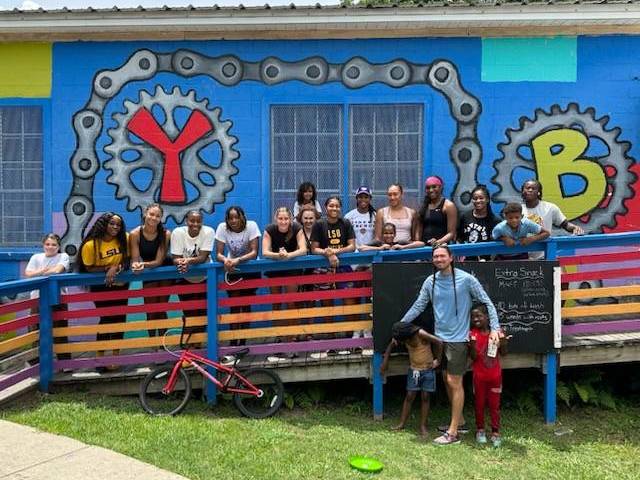
Front Yard Bikes provides vast youth programming, such as bike mechanics, welding, and gardening and educational/social services.
Several service-learning projects highlighted in the application include:
- LSU Community Playground Project – a partnership among various schools, town government, and community organizations, Volunteers in Public Schools (VIPS), and the LSU Department of Biological & Agricultural Engineering to foster student success and build support for public education across Louisiana. LSU biological engineering students have provided 1:1 tutoring to local pre-K through third-grade students as VIPS Reading and Math Friends. Throughout the semester, the service-learning students learn from children about their world of play and about the larger community to co-design playgrounds that reflect these interactions. Since 1998, 51 co-designed playgrounds have been built and serve approximately 10,000 children each day in locations throughout the state.
- Manship School of Mass Communication & the Louisiana Organ Procurement Agency (LOPA) – a partnership that has provided LSU Manship seniors with practical, professional experience in creating and executing campaigns to raise awareness of organ donors/donations in Louisiana since 2014. With more than 2,000 people on the waiting list for organ donation in Louisiana, LOPA’s work is instrumental in saving lives. This service-learning collaboration also produced Louisiana’s first children’s book on organ donation: Ava’s Wish, which helps families explain organ donation to children through the story of 6-year-old Ava Grace Branstetter, who lost her life in 2016. Two years ago, an LSU student team working with LOPA won first place in the National Organ Donation Awareness Campaign’s Public Relations Student Society of America (PRSSA) competition.
- Carver Branch Library, the East Baton Rouge Parish Library System, and the School of Education – a partnership that has provided a free four-week reading camp for elementary children to bridge the learning gap that occurs during the summer. Since 2013, LSU graduate students across two courses have refined their teaching techniques by delivering daily reading instruction and meeting the critical educational needs of an underserved neighborhood. Through this longstanding campus-community collaboration, Carver Library has seen a marked increase in daily patron volume (particularly children), the number of books checked out, and a steady yield of 14-30 new library cards issued during the summer camp.
- Front Yard Bikes (FYB) & the College of Humanities and Social Sciences – a partnership that provides ongoing support for the nonprofit’s nationally-recognized, vast youth programming, such as bike mechanics, welding, and gardening and educational/social services. LSU students enrolled in Dr. Becker’s course offerings over the last 15 years have received hands-on training in social science research methods and exposure to FYB’s youth-centered, strengths-based leadership development model. FYB has also welcomed mutually beneficial service partnerships with other campus units, such as the College of Human Sciences and Education and LSU Athletics.
- Greater Baton Rouge Food Bank & the School of Social Work – a partnership that has addressed food insecurity in Baton Rouge, one of the parish’s community-identified needs. The Food Bank relies on volunteers as part of its workforce to fulfill its mission of feeding the hungry throughout Baton Rouge and its surrounding parishes. Service-learning students enrolled in Introduction to Social Work learn how community organizations address this identified need and how social workers provide resources to clients who also face food insecurity. Since Fall 2022, an average of 140 students have volunteered at the Food Bank every academic year. With over 850 hours completed in 2024, the service-learning partnership was nearly 1.5% of the Food Bank’s reported 58,000 total service hours for that year.
LSU is one of four institutions in Louisiana to receive this distinction. The others are Franciscan Missionaries of Our Lady University, University of Louisiana at Lafayette, and Tulane University. A full listing of the institutions that hold the Community Engagement Classification can be found on Carnegie’s website.